Most people can recognize a handful of flags, but ask them what makes a flag truly unique and they’ll draw a blank. With 195 countries in the world, it’s easy to overlook the fascinating stories stitched into each design. If you’ve ever wondered which are the most interesting country flags and why they look the way they do, you’re in the right place. In this article, we break down the flags that stand out for their unusual shapes, bold symbolism, and rich historical meaning — giving you a whole new appreciation for these national symbols.
From the only non-rectangular flag in the world to designs hiding centuries of political history, these are the most interesting country flags — and the remarkable stories behind what makes them unforgettable.
Flags are one of the oldest forms of national identity. Every stripe, color, and symbol on a national flag tells a story — about a country’s history and culture, its struggles, its people, and its values. But while most flags follow a familiar rectangular template with simple stripes or blocks of color, a handful of national flags break every rule in the book.
Whether it’s an AK-47 on a flag, a white dragon breathing fire, or a shape that exists nowhere else on Earth, some flags demand a second look. This article explores the coolest flags from around the world, diving into the hidden meanings, unusual designs, and fascinating origins that make them truly stand out.
Use our Random Country Generator to discover these nations yourself — and see their flags come to life.
Nepal — The Only Non-Rectangular Flag in the World
When people think of flags around the world, they picture rectangles. Nepal’s flag tears that assumption apart entirely.
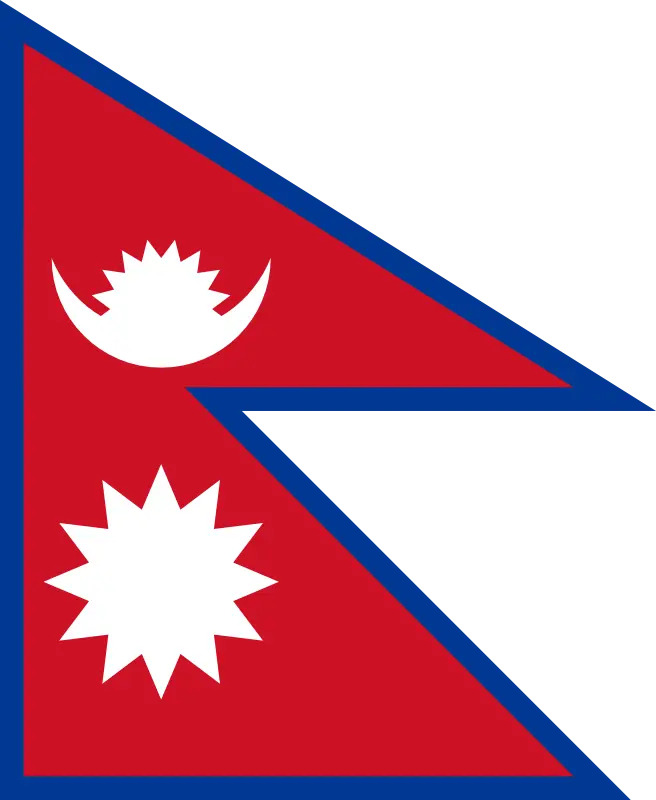
Nepal’s official flag is the only national flag in the world that is not a quadrilateral. It consists of two stacked pennants, forming a double-pennon shape that is completely unique among the flags of all 195 countries. The current flag was officially adopted on December 16, 1962, though its design draws from two separate pennants used by the royal house and the prime minister that date back centuries.
The flag features a crimson red field with a dark blue border. On the upper pennant sits a white moon, and on the lower pennant, a white sun — both celestial bodies that carry deep meaning in Nepalese tradition. The moon symbolizes the cool, calm nature of the Nepalese people, while the sun represents their fierce determination.
The rhododendron, Nepal’s national flower, inspired the red background — the same deep crimson that has defined Nepalese royal and military identity for generations. Together, the white for peace symbolism of the moon and sun against the red field creates one of the most visually striking flags in the world.
Nepal’s flag is one of only two national flags that are not rectangular — making it a permanent standout in any conversation about the strangest flags on Earth.
Bhutan — The Dragon Kingdom’s Roaring Banner
If Nepal’s flag wins for shape, Bhutan’s flag wins for drama.
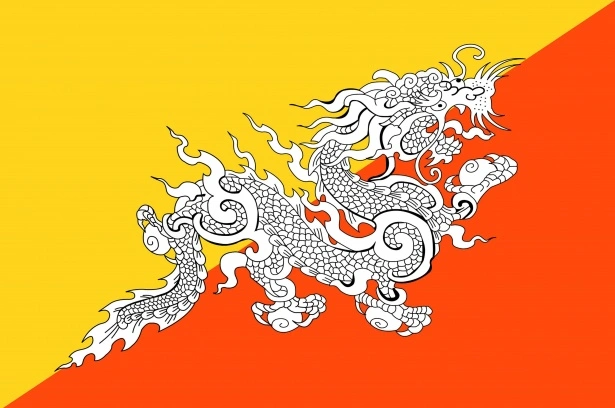
Bhutan’s flag features a white dragon — the Druk, or “Thunder Dragon” — clutching jewels in its claws, set against a background split diagonally between saffron orange and traditional dragon red. The white dragon represents purity and loyalty, while the jewels it holds symbolize the wealth and prosperity of the Bhutanese people.
Bhutan’s flag was adopted in its current form in 1969, though the dragon emblem has represented the kingdom for centuries. The saffron half of the flag symbolizes the secular power of the king, while the orange-red half represents Buddhist spiritual tradition — a duality that defines Bhutanese national identity.
Bhutan’s flag is genuinely one of the coolest national flags in the world, not just for its striking imagery but for how deeply every element reflects the country’s sovereignty, spirituality, and independence. Bhutan never gained independence from the United Kingdom or any colonial power — it remained sovereign throughout — which makes Bhutan’s flag a rare emblem of unbroken national identity.
Papua New Guinea — The Raggiana Bird-of-Paradise Takes Flight
Papua New Guinea’s flag is a visual masterpiece rooted in the natural world.
The flag is split diagonally — the upper triangle is red and black, the lower is black. On the red and black upper section, a golden Raggiana bird-of-paradise soars in full flight, while the lower section features the Southern Cross constellation in white stars on a black background.
Papua New Guinea achieved independence from Australia in 1975, and the flag was officially adopted that same year. The Raggiana bird-of-paradise is the country’s national symbol, representing freedom and the extraordinary biodiversity of the Pacific Ocean region. The Southern Cross connects Papua New Guinea to its geographical neighbors in the southern hemisphere.
Guinea’s flag — specifically Papua New Guinea’s — stands as one of the most artistically rich among flags around the world. The red and black color scheme, the golden bird in flight, and the starfield below create a composition unlike anything else flying above a government building today.
Mozambique — The Only Flag with an AK-47
Most flags symbolize peace and harmony. Mozambique’s flag takes a different approach.
Mozambique’s flag features a tricolor of green, black, and yellow horizontal stripes separated by thin white lines, with a red triangle at the hoist. Inside that triangle sits a crossed hoe and AK-47 rifle, overlaid with an open book and a star. It is the only national flag in the world to feature a modern automatic weapon.
The flag was officially adopted in 1983, though a version of it was originally adopted when Mozambique gained independence from Portugal in 1975. The AK-47 represents the country’s armed struggle for liberation. The hoe symbolizes agriculture and the labor of the people, the book represents education, and the star reflects Marxist ideology from the independence era.
Mozambique’s flag divides opinion but cannot be ignored. It is arguably the most politically loaded design among the strangest flags in existence — a permanent record of a nation’s revolutionary origins stitched into its national symbol.
Kyrgyzstan — The Sun and the Yurt
The flag of Kyrgyzstan is one of the most geometrically fascinating flags around the world.
Set against a red field, the flag features a yellow sun in the center with 40 rays — each ray representing one of the 40 tribes united by the legendary hero Manas. But the true standout is inside the sun: a tunduk, the circular crown of a traditional Kyrgyz yurt, rendered in red lines against the yellow circle.
The tunduk is the opening at the top of a yurt through which light and air enter — a national symbol of home, hearth, and the nomadic heritage of the Kyrgyz people. When you look at the flag of Kyrgyzstan from above, it is as if you are lying inside a yurt looking up at the sky.
The current flag was first adopted in 1992 after Kyrgyzstan gained independence following the dissolution of the Soviet Union. Few flags in the world manage to encode an entire way of life into a single circular emblem the way the flag of Kyrgyzstan does.
Mongolia — The Soyombo Symbol
Mongolia’s flag carries one of the most complex national symbols of any flag in the world.
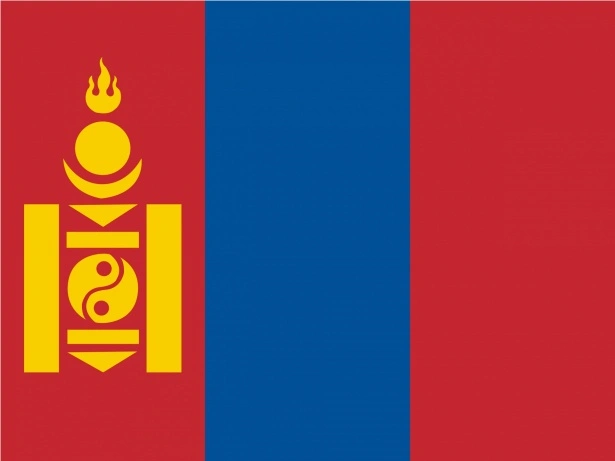
The flag is a vertical tricolor of red, blue, and red — the blue represents the sky, a sacred color in Mongolian tradition, while the red on both sides symbolizes progress and prosperity. But the centerpiece is the Soyombo symbol on the left red stripe, a complex geometric emblem that functions as a national symbol of Mongolia.
The Soyombo was created in 1686 by the Buddhist monk and scholar Zanabazar. It contains a flame at the top (representing prosperity), a sun and crescent moon (celestial bodies symbolizing eternal existence), two triangles (spear tips representing the defeat of enemies), two horizontal bars (representing honesty), the yin-yang symbol, and two vertical bars representing the unity of the Mongols.
The current flag was officially adopted in 1992. The Soyombo is also found on Mongolian currency, government seals, and military insignia — making it one of the most meaningful national emblems of any country.
Isle of Man — Three Legs Running
The Isle of Man’s flag features one of the oldest and most unusual symbols in heraldry: the triskelion.
The triskelion on the Manx flag consists of three armored legs bent at the knee, joined at the thigh, and arranged in rotational symmetry — three legs, running in a circle, on a red field. The symbol has been associated with the Isle of Man since the 13th century and remains one of the most instantly recognizable emblems on any flag today.
The official flag was first adopted in 1932. The three legs are said to symbolize the island’s motto — “Quocunque Jeceris Stabit,” meaning “Whichever way you throw it, it will stand” — a statement of resilience and stability that the Manx people have carried for centuries.
The triskelion also appears on the flag of Sicily, making it one of only a small handful of shared heraldic symbols across two very different regions of the world.
Belize — The Only Flag with Human Figures
Belize stands apart from virtually every other country in the world for one specific reason: its flag is the only national flag to feature human figures as a central design element.
The flag features a royal blue background with red stripes at the top and bottom. At the center sits the coat of arms of Belize, which includes two woodcutters — one holding an axe and one holding a paddle — standing on either side of a mahogany tree. Above them is a ship in full sail, and below them is a banner reading “Sub Umbra Floreo,” meaning “Under the shade I flourish.”
The coat of arms represents the logging industry that formed the backbone of Belizean colonial economy. The current flag was officially adopted on September 21, 1981, when Belize achieved independence from the United Kingdom. The blue and red represent the country’s two main political parties — an unusual nod to domestic politics embedded permanently into the national flag.
Brazil — A Flag Full of Stars and States
Brazil’s flag is one of the most data-rich flags in the world.
The green background represents Brazil’s lush forests and natural wealth. Centered on it is a yellow diamond symbolizing the country’s gold reserves, and inside that diamond sits a blue globe covered in white stars — 27 of them, each one representing one of the states of Brazil plus the Federal District.
The blue globe also carries a white banner with Brazil’s national motto: “Ordem e Progresso” — Order and Progress. The stars on the globe are arranged to reflect the night sky over Rio de Janeiro on November 15, 1889, the exact date Brazil became a republic.
The flag was originally adopted in 1889 and has been updated several times as new states were added, most recently in 1992. The combination of celestial bodies, political geography, and national philosophy makes Brazil’s flag one of the most intellectually layered among the coolest flags in South America.
Scandinavia — The Nordic Cross Family
No conversation about the most interesting country flags is complete without acknowledging the Scandinavian flags and their shared design language.
The Scandinavian flags — Denmark, Norway, Sweden, Finland, and Iceland — all feature the Nordic cross, a cross whose vertical bar is offset toward the hoist rather than centered. Denmark’s flag, the Dannebrog, is considered the oldest national flag still in use, with records dating back to the 13th century.
Each of the Scandinavian flags uses the Nordic cross but in distinct color combinations: Denmark’s red and white, Norway’s red with blue and white cross, Sweden’s blue with a yellow cross, Finland’s white with a blue cross, and Iceland’s blue with a red and white cross. The cross in all cases represents Christianity, which spread across the Nordic nations centuries ago.
The family resemblance across these flags is unmistakable — yet each one carries its own identity. Taken together, they represent one of the most cohesive flag design traditions among flags around the world.
Uruguay — The Sun of May
Uruguay’s flag is one of the most historically symbolic in the Americas.
The flag features nine horizontal stripes of white and blue, representing the nine original departments of Uruguay. At the upper hoist sits a white square containing the Sun of May — a golden sun with a human face, surrounded by alternating straight and wavy rays.
Uruguay’s flag was officially adopted in 1830. The Sun of May is shared with Argentina’s flag and represents the Inca sun god Inti, as well as the May Revolution of 1810 that began the independence movement across the Río de la Plata region. It is one of the most recognizable national symbols in South America.
What makes Uruguay’s flag particularly interesting is the Sun of May’s expression — rendered with a face, it gives the flag an almost personal quality, as if the nation itself is looking back at you.
U.S. — 50 Stars and 13 Stripes
The U.S. flag is one of the most recognized flags around the world — and one of the few that has been updated 27 times since its original adoption.
The current flag features 13 horizontal red and white stripes, representing the original 13 colonies, and a blue canton in the upper left corner containing 50 white stars — one for each state. The flag was originally adopted on June 14, 1777, a date now celebrated annually as Flag Day.
The most recent version of the U.S. flag was officially adopted on July 4, 1960, following Hawaii’s admission as the 50th state. The red and blue color scheme has become one of the most imitated tricolor traditions globally — though the U.S. flag is technically not a tricolor flag in the traditional European sense.
Flag Day, celebrated on June 14 each year, commemorates the original adoption of the flag and remains one of the few national observances dedicated entirely to a country’s ensign.
Albania — The Double-Headed Eagle
Albania’s flag is stark, bold, and ancient.
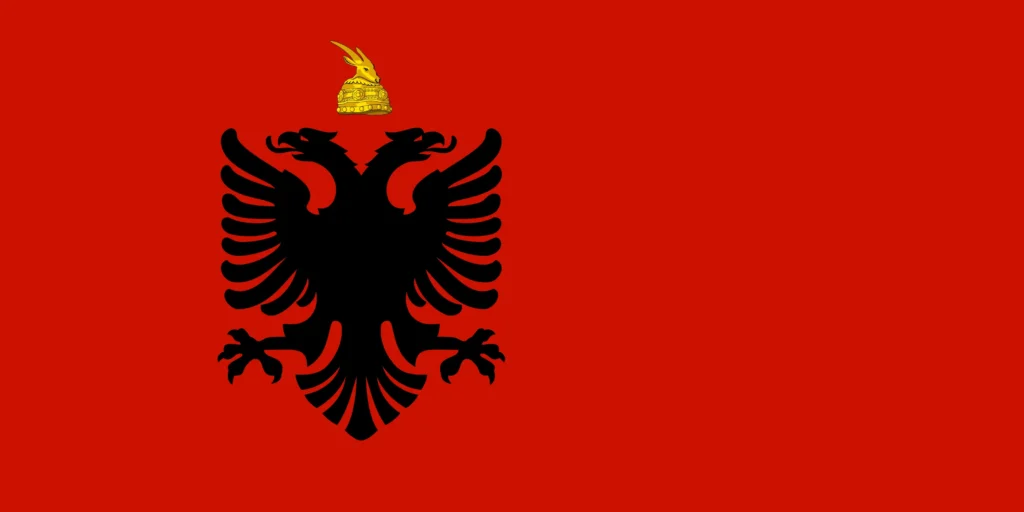
A plain red field. A black double-headed eagle at the center. That’s it — and it doesn’t need anything else.
The double-headed eagle has been Albania’s national symbol since the 15th century, when the national hero Gjergj Kastrioti Skanderbeg used it as his emblem during the resistance against Ottoman expansion. The current flag was officially adopted in 1912 when Albania gained independence, making it one of the oldest continuously used national emblems in Europe.
The red and black color combination — a red field with a black emblem — gives the flag an intensity that few others match. Among the coolest national flags in Europe, Albania’s is perhaps the most dramatically minimalist.
Mauritius — Four Colors, Four Communities
Mauritius carries its national story in four equal horizontal stripes: red, blue, yellow, and green.
The red represents the blood spilled in the struggle for independence. The blue represents the Indian Ocean that surrounds the island nation. The yellow represents the bright future that independence brought. The green represents the island’s lush vegetation and agriculture.
Mauritius achieved independence from the United Kingdom on March 12, 1968, and the flag was adopted that same day. Each of the four colors also represents one of the country’s four main ethnic communities — Indian, Creole, Franco-Mauritian, and Sino-Mauritian — making this a flag explicitly designed to represent a multiethnic society committed to peace and harmony.
The flag of Mauritius is one of only a handful of four-colored national flags in the world, and its symbolism of indigenous people and ethnic unity makes it one of the most socially meaningful flags in the world.
New Zealand — Stars, History, and the Union Jack
New Zealand’s flag sits at the intersection of colonial history and Pacific identity.
The flag features a dark blue background — the blue background representing the ocean and sky — with the Union Jack in the upper left corner and the Southern Cross constellation in red and white stars on the right. The Union Jack acknowledges New Zealand’s history as a British colony and its independence from the United Kingdom in stages through the 20th century.
The current flag was first adopted in 1902 and has remained unchanged since. New Zealand held a national referendum in 2016 on whether to change the flag — the vote narrowly kept the current design. The Southern Cross connects New Zealand to its Pacific Ocean geography and to neighboring Australia, which features the same constellation on its own flag.
New Zealand’s flag represents the tension many post-colonial nations face: honoring history while asserting a distinct national identity. It remains one of the most debated flags around the world.
Not sure which African flag to explore next? Use our random African country generator to discover a new nation instantly.
Discover These Countries for Yourself
Flags are just the beginning. Behind every national flag is a country full of history, geography, and culture waiting to be explored. Use our Random Country Generator to land on a random nation and start exploring — you might just discover your next favorite flag.
Curious about the world’s geography beyond flags? Check out our guide on how many countries are in the world, explore the largest countries in the world by area, or discover the least known countries most people have never heard of.
Frequently Asked Questions – FAQs
What is the most interesting country flag in the world?
Nepal’s flag is widely considered the most interesting for its unique non-rectangular shape — it is the only national flag that is not a quadrilateral.
Which country has the only flag with an AK-47?
Mozambique is the only country whose national flag features an AK-47 rifle, alongside a hoe and an open book.
What are the strangest flags in the world?
Among the strangest flags are Nepal (non-rectangular), Mozambique (AK-47), Isle of Man (three legs), and Bhutan (white dragon).
Which flag has a dragon on it?
Bhutan’s flag features a white dragon, known as the Druk or Thunder Dragon, clutching jewels against a saffron and red background.
What is the oldest national flag still in use?
nmark’s flag, the Dannebrog, is considered the oldest national flag still in use, with origins dating back to the 13th century.
Which country’s flag has human figures on it?
Belize is the only country whose national flag features human figures — two woodcutters as part of its coat of arms.
What does the Soyombo symbol on Mongolia’s flag mean?
The Soyombo is a complex national symbol representing fire, sun, moon, earth, water, and the Yin-Yang — symbolizing the eternal existence and independence of the Mongols.
Why does Nepal’s flag have two pennants?
Nepal’s double-pennon shape comes from the combination of two separate pennants historically used by the royal house and the prime minister, united into a single national flag.
What is Flag Day?
Flag Day is observed on June 14 in the United States, commemorating the original adoption of the U.S. flag on June 14, 1777.
Which flags share the Southern Cross constellation?
Australia, New Zealand, Papua New Guinea, Samoa, and Brazil all feature the Southern Cross on their flags, reflecting their location in or near the southern hemisphere.
A country’s flag can tell you a lot about its history, even for nations that rarely make headlines. For a closer look at the places behind some of the world’s most overlooked flags, check out our breakdown of the most obscure and least-known countries on the map today.